Showing posts with label opinion. Show all posts

Wednesday, 5 December 2018

The 'death' of Tumblr

 Over the last few days, the social media and blogging platform Tumblr has announced that from 17 December 2018 they will no longer be allowing any 'NSFW' images to be posted by users.

This move is thought to have come about after Apple suspended the Tumblr app from availability in their App Store, because a large amount of child pornography had gotten through Tumblr's filter software and ended up on the platform.

However, others in the industry have posited that in fact this move has been a long time in the planning, and is more to do with Tumblr no longer wanting to dedicate time, money and staff to policing the individual pieces of content uploaded to the 'NSFW' segment of the platform or improve their filter software, when it is more cost-effective for them to simply blanket-ban all images of sex and nudity. It's also speculated that making themselves more attractive to advertisers is another consideration that has led to them deciding that from 17 December onwards, Tumblr will be free of adult content.

This has understandably been a controversial decision, in part because Tumblr has spent the past 11 years as a platform which was known by many to permit users to share nude images and pornography, erotic art and writing, and more. That they would decide now, after more than a decade of giving a home to many people who saw Tumblr as an outlet for expressing their sexuality, or as a supportive community for non-sexual nudity in the name of body positivity, to ban all that content (even in the name of cleaning up their image) has taken a lot of people by unpleasant surprise.

The decision has also been controversial because it is seen by many as a "sledgehammer to crack a walnut" scenario (if the explanation that it relates to Apple pulling the app from their store is the correct one) - Apple's issue was that the filtering software used by Tumblr (software Apple requires all apps in its store to have to prevent any app from being used to share child pornography) was ineffective and not up to industry standard. Apple weren't being squeamish about consenting adult porn on the platform, and there has never been any suggestion from Apple that they see Tumblr banning all adult content as necessary to prevent the app being withdrawn again in future.

Almost all users of Tumblr would concur that child pornography should have no place on that platform or any other part of the internet, and would have welcomed any measures taken by Tumblr to shore up their defenses against users being able to upload child porn in future, but few would agree that blanket-banning all pornography and non-pornographic adult nudity is the only or best way to achieve this.

Perhaps the biggest aspect of this controversy is the way that it will affect the many users of the platform who openly value it for the way it enables them to find, share and generate adult-oriented content where other platforms (such as Instagram and Facebook) have already banned this.

Much of the outcry has come from the following groups: sex workers, who use Tumblr to advertise and promote their paid work and to network and establish communities (especially sex workers from marginalised groups such as the LGBTQ+ community, those who have physical disabilities or mental health concerns, and those who are involved in more unconventional kink and fetish scenes, all of whom have found support and safer generation of revenue through using Tumblr); creators of adult visual content (especially artists, both those in fandoms and in the general user population); and also promoters of non-sexual or sex-positive body-positive movements, for whom the sharing of male and female nude self-portraits is a communal act of empowerment and rebellion against traditional one-dimensional standards of beauty and gender conformity.

There is also a small naturist community on Tumblr who, I imagine, are once more aggrieved that images of non-sexual nudity are again being considered ban-worthy alongside sex-based content.

All of these people will be deprived of their primary reason for using Tumblr after December 17, and many will therefore be left with either no outlet at all for both creative expression and safe networking, or be forced onto other, less safe and user-friendly platforms. Additionally, content creators and sex workers who benefit from using Tumblr as a safe promotional tool will likely lose revenue as a result.

To add insult to injury, there is no suggestion that Tumblr will be cutting down on other problematic content, such as violence or hate speech. While I am sure the platform would not wish to be seen to be endorsing either, they appear disproportionately more concerned with sex and nudity than with violence or hate. It's an old story, of course.
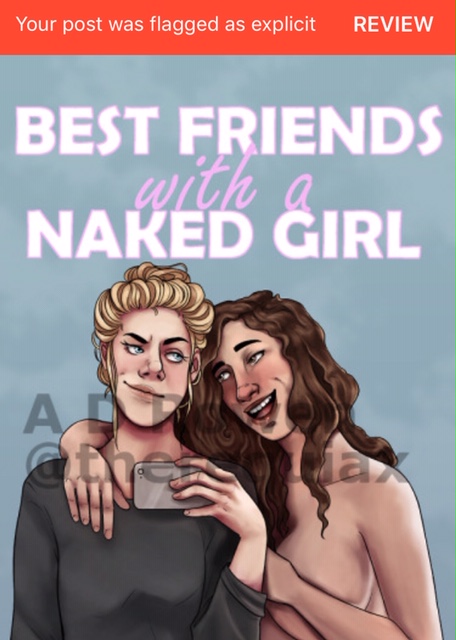
My book cover was apparently good enough
for Amazon but not for Tumblr...
Finally, users have been taking to Twitter to share examples of where Tumblr's automated content-review software (which was making red warning bars appear at the top of posts considered to be 'explicit' so that creators could appeal them if they were wrong) has flagged often laughably non-explicit images as explicit (as of today Wednesday 5 December, a lot of these warnings appear to have disappeared).

Ultimately, of course, Tumblr are free to choose what sort of content they do and don't allow on their platform. They are a private enterprise, they aren't obligated to allow adult content just to satisfy freedom of speech in the US (where they are based) or any other country. While there have been a number of users advocating for petitions or various other rebellious tactics, I doubt they will have impact on the company's decision or the way it will be implemented. Statistically, adult content accounts for approximately 1% of all user content on Tumblr (that's not to say there isn't still a lot, but it is vastly, enormously outnumbered by general content), an acceptable amount to lose. The only reason Tumblr is doing this is because it can make more money than if it doesn't.

On the other hand...
I suspect most content-creators know this: those I have seen are already packing up shop, upping sticks for other platforms ahead of the ban, for fear that if they wait too long, they will be simply obliterated from the site like the poor souls in Marvel's Infinity War film, their accumulated audience not knowing what has happened to them.

My history with Tumblr goes back many years. I have used Tumblr as a platform as both a general user and as a creator of erotic content, and I've had several Tumblrs over the years. I have a number of friends I have made through Tumblr who have either been or gone on to sex work, or who have been body-positivity and sex-positivity advocates, or promoters of a naturist lifestyle. None of those people would have been there if Tumblr didn't allow the content they were posting, content which will now be forbidden from 17 December.

I don't deny there were issues with adult content on Tumblr. A great many adult accounts were porn-sharing bots, usually aimed at promoting pay sites by randomly reposting images with links underneath. There was also a grey area of consent, whereby body-positive activists and naturist-types might share nude images without a sexual context, only for those images to be reblogged in a different context on porn blogs. A plus-size friend who shared nudes of herself to promote positive female body image described playing almost a game of whack-a-mole with all the chubby-fetish blogs who would keep sharing her pictures; for every one she asked to take her photo off their blog, another would pop up. Even when she captioned her photos warning porn blogs against reblogging her, they would simply delete the caption as they reposted.

But while these issues needed to be addressed, I don't think anyone experienced with the adult side of Tumblr would have advocated banning all images of sex and nudity altogether as the only or best solution.

It's perhaps unsurprising that these promotional
images for Brave Nude World have been flagged
As a writer, I find that Tumblr is perhaps my least-used platform to promote my work, but starting out it was the source of most of my inspiration. I browsed adult-oriented Tumblrs and when I saw images that appealed to or inspired me, I would reblog them with a short story attached (usually one or two paragraphs, a snapshot of a moment). Invariably, given the type of fiction I write, these were pictures of naked women and stories about how and why they came to be naked. I soon graduated to longer prose and then novels, but most of my old stories were still on Tumblr. I imagine they will disappear too come December 17, along with the graphics I created to promote my book Brave Nude World when that was published earlier this year. All feature nudity; all are deemed no longer acceptable.

Whether explicit text is to be banned along with explicit images remains to be seen; presumably it is a question of cost and man-hours setting up and maintaining software which can read text posts and flag them as objectionable, and at the moment Tumblr is concentrating on the image and video posts and not the written ones. But I am sure it is only a matter of time.

So I'll be saying goodbye to Tumblr. As a producer of adult content I am no longer welcome there, even if that content itself still flies under their radar (and as I have said, much of it will not). They have made that perfectly clear. I shall survive and thrive, I am not concerned for myself. I have Amazon and Literotica and Twitter and this blog, they are more than enough in terms of outlets. But there are a great many people who will be hurt, massively hurt, by Tumblr's decision, not least because many have spent years, perhaps even a decade, amassing followers and building and participating in a safe and welcoming community which will be soon to disappear.

Friday, 16 November 2018

Ten writing "rules"

My apologies for once again finding inspiration for a blog post from something that has been trending on Twitter! But over the past couple of days, fellow writers and others have been having a lot of fun with US novelist Jonathan Franzen's recent appearance in an article for LitHub, in which he offers his ten rules for aspiring authors.

As you would expect from someone who has been a successful and established literary author for some time, Franzen has a particular set of opinions which seem to be both largely divorced from the reality of experience for many people attempting to write novels, and also particular to his own experience and privilege. Where they aren't tin-eared to reality, his rules are nebulous and vague (what could "you have to love before you can be relentless" possibly actually mean, and who could this ever help?).

Author Twitter, of course, has had a field day making fun of Franzen's "rules", with many different writers offering their own takes on advice they would recommend fellow authors follow. Some is comedic, some genuinely attempting to be helpful, while others mix the two.

Although I doubt anyone needs it, here is my own list of ten rules I would suggest aspiring writers follow (tongue firmly in cheek, of course):

  1. Don’t care about word count (unless you’re being paid by the word in which case, use as many as possible, even if it doesn’t make sense purple monkey dishwasher)
  2. Don’t care about other people’s word count (even if it’s NaNoWriMo – it literally doesn’t matter)
  3. If you aren’t enjoying it, stop and don’t go back until you enjoy it again. This might take a while but what is the point of writing if you hate it? It’s hard enough to make a living doing it if you like it!
  4. Don’t be afraid to edit as you go, your first draft doesn’t have to be a stream-of-consciousness
  5. Don’t worry if your first draft needs masses of work, that’s what editing is for
  6. Write in the environment that works best for you, whether that’s naked in the dark in isolation or plugging away at a laptop in a busy coffee shop
  7. Don’t write naked in a busy coffee shop, though
  8. Do as much research as your work demands, whether at the library, via the internet, or by talking to people who can add something to your narrative
  9. If you haven’t researched, keep things big and vague and you will probably get away with it unless you write historical fiction or something techy about planes or tanks, in which case, someone will tear you a new arse on the Amazon reviews for having a character use slightly the wrong type of teacup or fix their engine with the wrong spanner
  10.  A bit of ego is fine but don’t go around lording it over other writers like you are God’s gift to literature. You aren’t Tolstoy (unless you’re Tolstoy, in which case congratulations on defeating death and discovering the internet). Your work might change someone’s life but more than likely it will just briefly entertain them, and that’s good enough

Friday, 12 October 2018

Publishing Platforms for the Indie Writer

A post and conversation on Twitter the other day has inspired this blog post's topic; as a self-publishing indie writer of erotica, which do I think is the better option for an author to take - publishing an e-book via multiple platforms, or opting into Amazon's Kindle Unlimited service, which requires exclusive availability?

I should preface this by saying; I am no expert on self-publishing. I have two novels in the marketplace, both niche erotica. I have been doing this for less than a year. I write for fun and not profit, although I am pleased that the success of my novels has exceeded my expectations. There are people who have written entire books, blogs and websites about how to maximise your earnings as a self-published author in both the mainstream and adult-only marketplaces, and there are a great many authors who make a sizeable, even liveable, income from self-published e-books. If they have something to say about platforms and exclusivity, their advice probably comes from a more informed, researched and considered position than mine does!

That aside, I can talk about my own experience within my narrow field.

Firstly, an explanation. When you as an author choose to publish a novel or story or other work as an e-book, currently you face a choice as to what option you take.

You can choose to make your book available across multiple platforms, so that different retailers can sell it. Obviously the main one of these is Amazon, they have come to dominate the marketplace for both electronic books (the Kindle is the market leader in e-readers) and traditional books. But there is also Smashwords, who function as both a marketplace for e-books and a distributor to other retailers (such as Barnes & Noble) as well as several others, including specialist retailers.

That is one option. The other is that you can opt to sell exclusively with Amazon Kindle Direct Publishing (KDP Select) and not have your e-book available via any other digital platform. The incentive Amazon offers for this exclusivity is that you can then be entitled to some of the 'pot' of royalties for Kindle Unlimited, Amazon's subscription-based virtual lending-library (KOLL), as long as readers can borrow your book via KU. Amazon pays you a small sum per page read on KU, with the amount being dictated by the overall size of the pot, which grows as they get more subscribers.

(It should go without saying that if you don't want to make your book available via KU, you have no requirement to go Amazon-exclusive and indeed the best option for you will doubtless be multi-platforming).

So while at first glance this would seem to be a no-brainer (more platforms = more potential sales = more potential royalties), having a book available via KU has a number of selling points; especially if you are an author of erotica or other less-mainstream genres.

When I began selling books, I didn't actually realise that KU required your book to be available exclusively through Amazon. Chalk that up to eager excitement on my part to publish - I simply didn't read all the terms before hitting 'publish'. As a result, for a couple of months I had a book available on both KU, and also via a non-Amazon retailer, in this case Smashwords.

I don't recommend doing this. While Amazon is so vast it is possible to 'game' both marketplaces (at least in my experience for a short time) as your books tend to fly under the radar of the various automated processes they have to keep track of things (unless someone actively reports that they are not exclusive) it is a breach of your terms and will undoubtedly lead to some sort of punitive action from Amazon if they find out - with ignorance being no excuse. In the end, when I realised, I opted to remove my books from Smashwords and keep them Amazon exclusive and in the KU scheme.

My reason for choosing that option, ultimately, came down to the fact that I was getting more readers through KU than I was through Smashwords. My sales on Smashwords had started well, but had petered out to almost nothing by the time I discontinued selling through them. I also wasn't confident that Smashwords was as secure as Amazon in terms of being able to protect my work from being pirated, due to the wide variety of file formats they made books available in (including .pdf). While this is great for accessibility, it also greatly increases the risk of your book being circulated for free without your permission, in my opinion.

So compared to Smashwords, KU was performing much better for me. It's true that the amount you receive per page view is small, but overall my total income from KU pageviews is about half as much as my income from book sales on Amazon, whereas my income from Smashwords had peaked at 25% what I was earning from Amazon sales and had dropped to less than 10% by the time I took the books off that platform.

It's perhaps understandable that a book on Smashwords doesn't perform as well as it does on Amazon. Amazon dominates the marketplace to the point that the existence of alternative retailers for e-books is not well-known. I hadn't heard of Smashwords until I began investigating platforms for self-publishing, and as authors who often mostly interact with other authors, we can become ignorant of the fact that sites like Smashwords might be common knowledge to us, but are not always well-known to consumers.

That said, Smashwords has one major selling point for me, and that's the fact that it is an authorised distributor serving Apple iBooks, which I think is Amazon's main competitor in the e-book market. So while Smashwords itself might not be on the radar for many consumers, the places it distributes books to may well be. I don't think I personally made enough of the Apple connection when I was promoting my books, and had I done so it might have benefited me somewhat; that said, it is more difficult for authors to market works on iBooks directly to readers in my opinion as Apple doesn't have a webstore in the same way as Amazon; browsing and purchasing is done via the app. That said, Apple does offer a lot of tools to aid authors who wish to use them.

For me, however, opting to be Amazon KDP exclusive to be enrolled in KDP Select and have my book available for lending via KU was the right option.

-

So how can you know if it is the right option for you? Here are a few criteria I think can be considered:

Am I publishing a novel or a short story?
If you're publishing a story that isn't very long, you probably aren't going to receive a lot of money each time someone reads it on KU. It may be better to have it available through multiple platforms for a set price than have it for 'free' to subscribers so you will be paid per page read. However a novel of 200 pages or so will probably generate a little more income, provided everyone who downloads it reads to the end!

On the other hand, short stories still do well on KU because many readers may not consider them good value for money as a purchase compared to a novel priced around the same amount, but may be more inclined to read them if they are getting them as part of their KU subscription. I had a KU subscription for a few months and read a lot more short stories than I normally purchase, because I didn't feel short-changed as a consumer by the comparative costs.

(There are authors who claim to have found ways to game the Amazon KU system and some websites that will tell you how this can be achieved (book-stuffing etc.), I am not a supporter of this approach however, mostly because it creates a bad experience for the unwary consumer).

How much effort do I want to put into marketing my book?
One of Amazon's key advantages over its competitors is the size of its customer base and the tools it has set up to market books and other products to them. Even if you do almost nothing to promote your book to a wider readership, you will probably still sell some copies if it's on Amazon, and having it available to loan to KU subscribers will probably increase that attention.

Most authors I have encountered who report success across multiple platforms are those who take their time to do a lot of marketing and promotion of their books via social media, via their own websites and so on. If you are constantly putting out word about your books, no matter where they are available, you are maximising interest; but many authors either lack the time to put this kind of work in, or just aren't interested in playing this game. For myself, I am probably in the middle ground; I would much rather spend the little free time I have writing than I would advertising, but I also enjoy social media and blogging. If you're prepared to put the work in, you might find you don't need KU, but it is a lot of work to raise awareness about alternative platforms when they struggle to find an audience themselves due to Amazon's marketplace dominance, and you often seem to end up having to market the platform almost as much as you market the book you are selling on it.

Am I writing something that may prove too controversial for Amazon?
This is especially pertinent for someone writing erotica. All e-book retailers have rules about what they consider acceptable content, and some are stricter than others. For example, Amazon say that they don't allow erotica in which the theme is incestuous relationships between family members. I don't write about those themes myself, but I know some of those who do find careful ways to get around Amazon's rules; but there is always the risk Amazon will be alerted to the content of your book or else your work will be caught up in one of their legendary purges. So if you write, say, mother-son incest, it is probably best not to put all your eggs in one basket (and really, Amazon's rules say you should avoid their platform altogether). Other platforms are more lenient, and may represent a better option.

More generally, a point I have made before is that consumers of erotica are not necessarily looking for what I call a 'forever book' - that is, something they will keep and return to again and again. They're looking for something to read for a particular experience or thrill and once they have read it they will move on to the next novel or story. In that regard, the lending function of KU is perhaps the best option for erotic works as it enables readers to get the thrill-read they desire without asking them to spend money on an individual transaction.

Do I just not like Amazon?
It sounds flippant. But much the same as many big multi-national companies, Amazon has more than its fair share of critics and people opposed to them on ethical grounds. Amazon boss Jeff Bezos has more money than God and is growing richer everyday; meanwhile there are stories of incredibly poor treatment of Amazon's warehouse workers and exploitation of loopholes to limit the amount of money Amazon pays in taxes to the countries it operates in. More generally, there is the undeniable impact online retailing has had on the book marketplace, with many physical bookstores - both independents and chains - struggling to stay afloat, unable to compete with the lower prices of the Amazon monolith.

So there is definitely a discussion to be had about whether, as an independent author who has free choice over where to sell your books, you should actually rebel against Amazon's market dominance and make your work as widely-available as possible.

Even if you're someone like me, who does not have any real ethical qualms about selling on Amazon, you should recognise that a healthy marketplace needs some competition. For instance, the percentage Amazon pays in royalties to its self-publishing authors is currently priced competitively with other platforms like Smashwords and iBooks, in order to encourage authors to use the Amazon KDP platform. If Amazon eliminated its competitors, they would have no need to offer a competitive percentage in royalties; they could throw authors a pittance and keep the rest in profit, and the authors would have no recourse because it wouldn't be as though we could take our books elsewhere. So as e-book authors it can be argued we do have a long-term advantage to multi-platforming in order to protect our income now and in the future by helping to maintain a diverse marketplace.

-

In the end, what works for one author might not be the best option for another, and every way of doing things has its advantages and disadvantages. But the beauty of being a self-published writer is having the control over how you distribute your work; if something isn't working for you, changing how you do things is easy, and entirely in your hands.